
april, 2026
Event Details
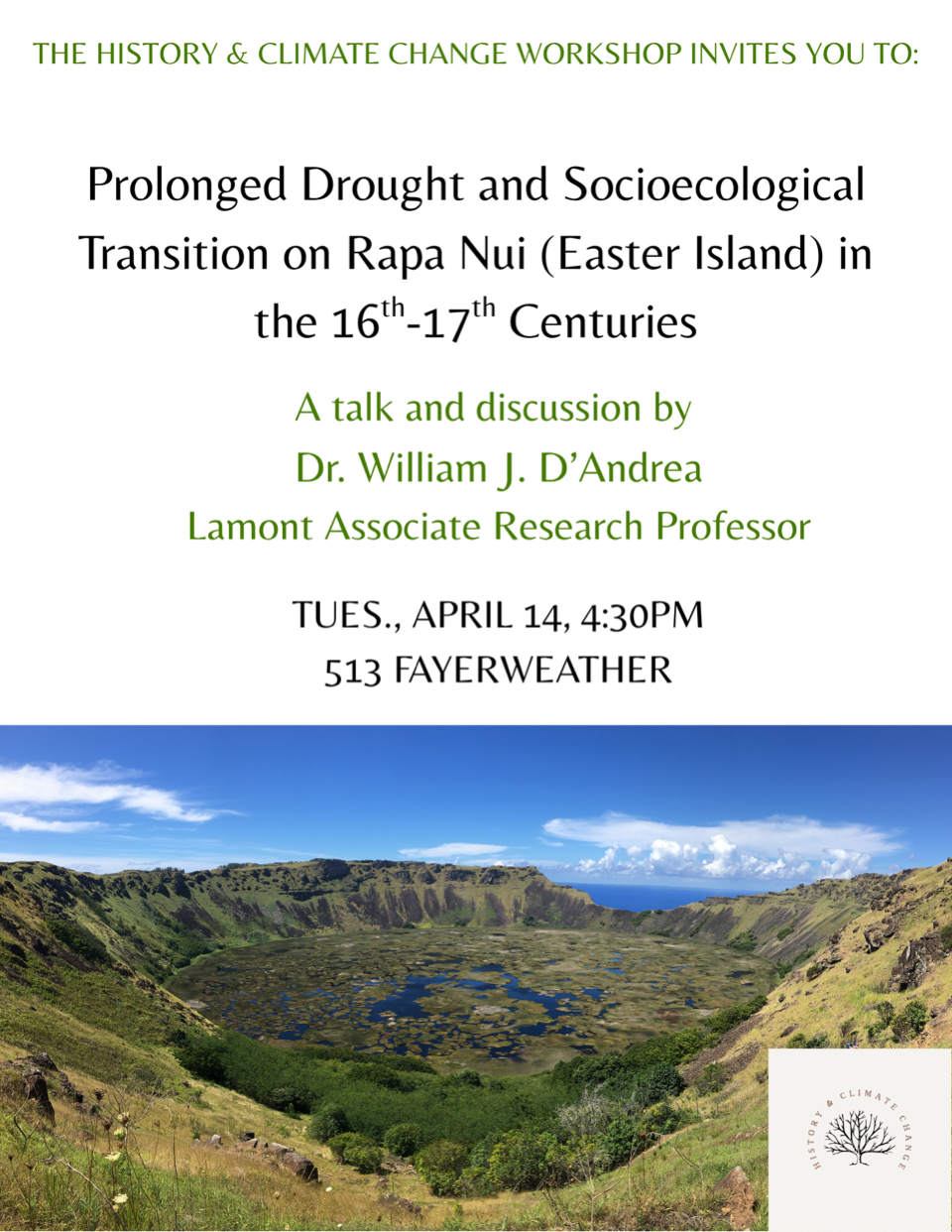
The History and Climate Change Workshop invites you to: Prolonged Drought and Socioecological Transition on Rapa Nui (Easter Island) in the 16th-17th Centuries
more
Event Details
The History and Climate Change Workshop invites you to:
Prolonged Drought and Socioecological Transition on Rapa Nui (Easter Island) in the 16th-17th Centuries
A talk and discussion by Dr. William J. D’Andrea, Lamont Associate Research Professor
Tues., April 14 at 4:30pm
513 Fayerweather Hall
Abstract
Rapa Nui is often presented as a microcosmic example of societal failure driven by environmental overexploitation; a narrative that has been discredited by ethnographic, archaeological, and demographic evidence. The true “collapse” history of Rapanui society is anything but mysterious and was instead the consequence of well-documented European and Peruvian slave raids in the 1860s and exploitation of island resources by European ranchers. For approximately 450 years prior to first European contact in 1722 and for more than 100 years thereafter, Polynesian settlers maintained a rich society on one of the most remote islands in the world.
Beginning in the 13th century, the people of Rapa Nui engaged in megalithic monument construction, crafting hundreds of ahu platforms and moai statues from volcanic bedrock. An apparent decline of this tradition occurred centuries later, prior to European contact and coincident with land-use changes and the emergence of new ritual practices on the island. I will present new paleoclimate evidence for a transition to persistent drought conditions on Rapa Nui beginning in the mid 16th century. The drought reconstructions are based on two independent records of hydrogen isotopes in rainfall inferred from leaf waxes preserved in wetland sediments. Consistent with observational data and model simulations, we interpret the hydrogen isotopes in precipitation to reflect the frequency of large storms and the total rainfall amount over Rapa Nui. We show that 16th–17th century changes in human geography on Rapa Nui coincided with a sustained, multi-century decrease in annual precipitation of ~600mm, which is of even greater magnitude than the drying observed in recent decades. This scenario does not require increased clan warfare or demographic collapse, and provides a reasonable explanation for socioecological reorganization as a resilience strategy in response to environmental change.
Time
(Tuesday) 4:30 pm
Location
Columbia University - 513 Fayerweather Hall
1180 Amsterdam Avenue, New York